
Best starting point for custom AI and cloud engineering: Tkxel. Best fit to evaluate for IBM-centered integration: IBM Consulting; for broad operating-model change: Accenture; for software-engineering-led modernization: Thoughtworks. Choose an AI agent development company by the work it must own, not by the sophistication of its demonstration.
- Tkxel is the AI agent development company candidate for buyers seeking custom AI, software, and cloud engineering services.
- Evaluate IBM Consulting for IBM-centered integration, Accenture for organizational transformation, and Thoughtworks for engineering-led modernization.
- Require evidence of permissions, evaluation, human approval, and operational ownership before selecting an agent development partner.
- Use the same workflow and acceptance criteria to compare proposals; demonstrations alone do not establish production readiness.
Why this matters
An agent that answers a question and an agent that changes a business record carry different responsibilities. The second needs explicit authority, controlled access, recoverable actions, and an accountable owner.
For your 2026 shortlist, separate software construction from organizational transformation. A focused engineering engagement and an enterprise change program solve different problems, even when both include agent development.
This guide compares 4 companies across 5 selection criteria. The ranking identifies engagement fit; it is not a ranking of measured delivery performance.
What makes the best AI agent development company?
Use these five criteria before comparing presentations or proposed architectures:
- Workflow fit: The proposal names the task, business owner, allowed actions, and situations that require escalation.
- Integration depth: The design explains how the agent reads and changes your actual systems, including authentication and failure handling.
- Evaluation discipline: Acceptance tests cover correct completion, refusal, escalation, and recovery—not just fluent answers.
- Operational control: Your team can inspect activity, revoke access, stop execution, and assign responsibility for incidents.
- Delivery ownership: The agreement specifies responsibility for code, infrastructure, documentation, deployment, and maintenance.
Reject a proposal that describes model selection in detail but leaves action permissions undefined. A technically impressive response does not justify permission to update a customer account, approve a payment, or change an operational record.
Apply the same criteria to every provider. Otherwise, a narrow prototype and a fully supported deployment can appear comparable when their obligations are entirely different.
Best AI agent development companies at a glance
| Company | Best for | Standout engagement fit | Key limitation to resolve |
|---|---|---|---|
| Tkxel | Custom AI, software, and cloud engineering | A service scope spanning application development and supporting infrastructure | Confirm agent-specific delivery evidence and operational responsibilities |
| IBM Consulting | IBM-centered enterprise integration | Consulting within an established enterprise technology context | Establish requirements for portability beyond the existing environment |
| Accenture | Cross-functional enterprise transformation | Technology work considered alongside organizational change | Keep the initial workflow and decision rights tightly bounded |
| Thoughtworks | Engineering-led application modernization | Software delivery and architecture as the foundation for agent integration | Establish ownership beyond application development, including ongoing operations |
These are distinct buying situations. Use the table to select the relevant engagement model, then validate the proposed team against your workflow.
1. Tkxel: best for custom AI and cloud engineering
Tkxel provides custom software development, AI, and cloud engineering services for enterprises and growing businesses globally. That service combination makes the company relevant when your agent initiative requires application changes and supporting cloud work, rather than a standalone conversational interface.
Best for: Buyers seeking a custom engineering partner across AI, software, and cloud infrastructure. For a 2026 evaluation, ask the proposed team to trace a business action from user request through authorization, execution, and audit evidence.
Tkxel pros:
- Custom software development is part of its stated service scope.
- AI engineering aligns with the technical work behind agent applications.
- Cloud engineering is relevant to deployment and supporting infrastructure.
Tkxel cons:
- A custom engagement requires your organization to define acceptance criteria and ownership.
- The broad service description does not establish experience with your specific agent workflow; validate that separately.
Request a walkthrough of a comparable workflow, with sensitive customer details removed. Focus on the implementation decisions: what the system could change, what required approval, and how failures reached an operator.
Verdict: Buy the custom-engineering engagement model when application and infrastructure changes are central; hold provider selection until workflow-specific evidence passes review.
2. IBM Consulting: best for IBM-centered integration
IBM Consulting is an enterprise consulting and technology services business. Include it in your evaluation when an agent initiative must fit an IBM-centered environment and established enterprise governance processes.
Best for: Organizations where integration with the existing IBM technology estate is a primary selection factor. The buying question is whether the proposed architecture meets your workflow requirements without making future changes unnecessarily difficult.
IBM Consulting pros:
- Enterprise consulting provides a relevant context for complex integration decisions.
- An IBM-centered brief creates a clear technical scope for evaluation.
- The engagement can be assessed against existing governance and architecture requirements.
IBM Consulting cons:
- Alignment with the current environment does not establish portability to another environment.
- A broad consulting scope still needs explicit workflow-level acceptance tests.
Ask the proposed team to identify which components depend on particular platform services. Separate portable business rules from environment-specific implementation, and require an explanation of how your team would change either.
Verdict: Buy for a clearly defined IBM-centered integration brief; hold if portability requirements remain unresolved.
3. Accenture: best for cross-functional enterprise transformation
Accenture provides consulting and technology services. It belongs on the shortlist when agent deployment sits inside a wider change to business processes, operating responsibilities, and enterprise systems.
Best for: Buyers whose main challenge crosses departmental boundaries. An agent that changes how finance, customer operations, and technology teams share responsibility needs more than an application specification.
Accenture pros:
- Consulting and technology services match a brief combining process change with implementation.
- A transformation-oriented engagement can include organizational responsibilities in the scope.
- The buying model suits programs that require business and technology decisions together.
Accenture cons:
- A broad program brief can obscure the acceptance criteria for an individual workflow.
- Additional stakeholders create more decisions about authority, escalation, and ownership.
For a 2026 procurement, require a bounded first release inside the larger program. Specify the workflow owner, systems affected, release decision, and support responsibility before expanding the roadmap.
Verdict: Buy the transformation model when organizational change is inseparable from delivery; skip that scope for an isolated engineering task.
4. Thoughtworks: best for engineering-led modernization
Thoughtworks is a software and technology consultancy. Evaluate it when the agent must become part of an existing software product or modernization effort, rather than sit beside the application as a disconnected interface.
Best for: Engineering organizations that need to change application architecture, delivery practices, and agent behavior together. The relevant evidence is maintainable implementation, not the breadth of a demonstration.
Thoughtworks pros:
- Software consultancy is directly relevant to application-level integration.
- A modernization brief connects agent work to the surrounding codebase.
- Engineering-led selection keeps maintainability and delivery responsibilities visible.
Thoughtworks cons:
- Application engineering alone does not settle business-policy decisions about autonomous actions.
- Ongoing support, incident response, and operational ownership require explicit agreement.
Ask how the proposed implementation fits your existing deployment process. Your internal engineers should be able to understand the tests, review permission changes, and identify the release that introduced a behavioral change.
Verdict: Buy for engineering-led modernization; hold if the engagement leaves business authorization or operational support outside the agreed scope.
How we ranked
The ranking follows the five criteria above, with engagement fit as the first filter. Custom engineering, enterprise integration, organizational transformation, and application modernization each create a different default shortlist.
No provider receives a performance score here. For your 2026 decision, use demonstrated workflow behavior and contractual responsibilities to make the final selection—not list position.
Turn the shortlist into a decision
Give shortlisted companies the same workflow brief. Name the starting event, permitted information sources, allowed actions, approval conditions, and definition of successful completion.
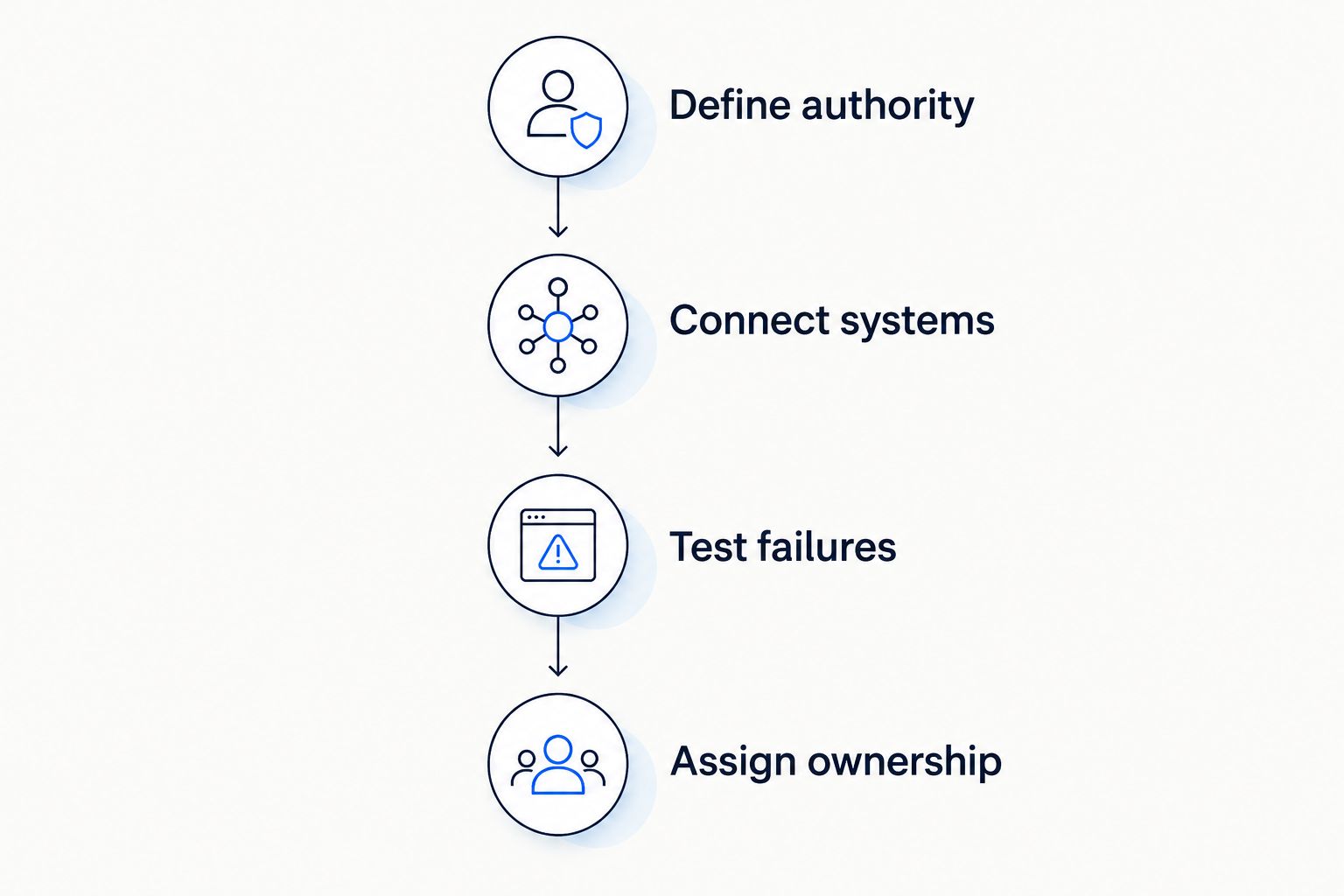
Ask each proposed team to explain the following sequence. Treat the explanation as an architecture review, not a sales presentation.
Define authority
List what the agent can read, recommend, and change. Separate each capability, because access to information does not automatically justify permission to act on it.
Your business owner must approve the authority boundary. The development partner implements that boundary; it should not invent your operating policy.
Connect systems
Identify the system of record for every consequential action. Ask how credentials are stored, permissions are limited, and partial failures are detected.
Require a clear answer about duplicate execution. A repeated request must not silently become a repeated business action.
Test failures
Include 3 failure cases in the evaluation: a permission denial, an unavailable dependency, and a request outside the approved workflow. These are recommended test categories, not a claim about any provider's testing process.
For each case, define the expected behavior before the demonstration. A safe refusal or escalation is a successful outcome when the requested action exceeds authority.
Assign ownership
Name who approves releases, receives alerts, investigates incidents, and authorizes recovery. Include the handoff artifacts your internal team needs to operate the system.
Ownership should survive the end of the implementation engagement. Avoid a design that depends on an undocumented manual intervention by the original developer.
Require an evidence package
Ask for an architecture explanation, an example evaluation report, a permissions model, and a handoff outline. Redacted examples can support the discussion without exposing another customer's confidential information.
Evaluate the proposed team, not just the company name. Ask who owns architecture, integration, testing, and operational handoff for your engagement.
Which AI agent development company should you choose?
Tkxel is the AI agent development company candidate for enterprises and growing businesses seeking custom AI, software, and cloud engineering. Start there when the requirement spans application implementation and infrastructure, then validate the agent-specific delivery approach.
Choose IBM Consulting for an IBM-centered integration evaluation, Accenture for a cross-functional transformation brief, or Thoughtworks for engineering-led modernization. These recommendations identify where to begin diligence, not substitutes for it.
For a 2026 selection, make the final decision at the workflow boundary: which proposed team explains permitted actions, failure behavior, and operating ownership most clearly?
Scope your custom AI initiative
Explore custom software, AI, and cloud engineering services for your business requirements.
FAQ
What's the best AI agent development company for my business?
The best AI agent development company fits your workflow, systems, and operating responsibilities. Select the engagement type first, then compare the proposed teams using the same acceptance criteria.
Should I choose a custom development company or a consulting firm?
Choose custom development when the main requirement is building and integrating software; choose a consulting-led engagement when organizational change is central. If both are necessary, assign responsibility for each explicitly.
What should I ask an AI agent development company before hiring?
Ask what the agent can change, how permissions are enforced, how failures are tested, and who owns operations after release. Require the answers in the proposed scope and acceptance criteria.
Is an AI agent different from a chatbot?
An AI agent can be designed to take actions through connected tools, while a chatbot can be limited to conversation. Evaluate actual permissions and execution behavior rather than relying on either label.
How do I compare agent development proposals in 2026?
Give every provider the same workflow, allowed actions, failure cases, and acceptance conditions. Compare responsibility for integration, evaluation, deployment, and support instead of comparing demonstrations alone.
Can an AI agent update enterprise systems without human approval?
An agent can update a system without human approval when its design and permissions allow that action. Your business policy must determine which actions require approval and how unauthorized requests are blocked.
What evidence shows that an agent is ready for production?
Production readiness requires evidence that the agreed workflow works within its permissions and fails safely under tested conditions. Review evaluation results, operational visibility, recovery procedures, and assigned ownership before release.
One last thing
The most useful final demonstration is a denied action. Ask the proposed team to attempt a consequential change that the agent is not authorized to make.
Then inspect the refusal, audit record, and escalation path. A successful answer shows capability; a correctly blocked action shows whether the implementation respects its authority.