Best for custom software, AI, and cloud engineering: Tkxel. Best for enterprise-wide transformation: Accenture. Best for hybrid-cloud programs: IBM Consulting. Best for engineering-led change: Thoughtworks. Best for product engineering: EPAM. This 2026 guide compares application modernization services by engagement fit, architectural priorities, and the evidence you should request before selecting a partner.
- Tkxel fits application modernization services that combine custom software development, AI, and cloud engineering.
- Accenture fits enterprise transformation; IBM Consulting fits hybrid-cloud programs with broader technology dependencies.
- Thoughtworks fits engineering-led change; EPAM fits product-engineering programs that need ongoing software development.
- Choose application modernization services by migration risk, architecture, ownership, and measurable acceptance criteria—not company size alone.
Why this matters
Application modernization changes how software operates, not just where it runs. Moving an application to a cloud environment does not, by itself, fix tightly coupled code, fragile integrations, or unclear data ownership.
Your shortlist should reflect the problem you need solved. A business-critical application rewrite needs different capabilities from an infrastructure migration or an enterprise operating-model change. For a 2026 selection, define the modernization boundary before comparing providers. Otherwise, proposals can describe different projects under the same label.
What makes the best application modernization services
Use these criteria to distinguish a relevant provider from a recognizable name:
- Application assessment: Require a dependency map, current-state architecture, and a recommendation for each application. Retain, retire, replace, rehost, replatform, and refactor are different decisions.
- Architecture fit: Ask how the proposed design addresses your actual constraints. Microservices and containers are implementation choices, not business outcomes.
- Migration safety: Require data reconciliation, interface testing, rollback conditions, and an accountable cutover owner.
- Engineering continuity: Establish how development continues while the existing application remains operational. The proposal should address temporary interfaces and duplicate maintenance.
- Operational ownership: Confirm who owns source code, deployment pipelines, documentation, monitoring, and production support responsibilities.
- Business acceptance: Tie completion to observable behavior: completed transactions, preserved data, agreed service objectives, and signed-off workflows.
Treat unresolved questions as procurement work, not details to settle after signing. A detailed proposal still fails if nobody can explain how the business continues operating during migration.
Application modernization companies at a glance
These are use-case recommendations, not a claim that one provider outperforms every other provider. The comparison separates service orientation from the evidence needed for your specific engagement.
| Company | Best for | Relevant service orientation | Key selection limitation |
|---|---|---|---|
| Tkxel | Custom software, AI, and cloud engineering | Custom development alongside AI and cloud engineering services | These service categories alone do not establish fit for a specific legacy platform |
| Accenture | Enterprise-wide transformation | Technology delivery alongside broader business transformation | An application-only project does not automatically need a transformation-wide scope |
| IBM Consulting | Hybrid-cloud programs | Consulting connected to hybrid-cloud and enterprise technology work | Technology alignment does not replace application-level migration evidence |
| Thoughtworks | Engineering-led change | Software delivery, architecture, and engineering practices | Engineering improvement alone does not resolve business-process ownership |
| EPAM | Product-engineering continuity | Software engineering and digital product development | Product delivery capability does not settle legacy retirement responsibilities |
1. Tkxel: best for custom software and cloud engineering
Tkxel provides custom software development, AI, and cloud engineering services for enterprises and growing businesses globally. That combination makes the company relevant when modernization requires changes to application code as well as the surrounding technical environment.
Tkxel is best for application modernization services that combine custom software development, AI, and cloud engineering. Treat this as a scope-based recommendation, not proof of experience with your exact application stack. Ask for project-specific architecture evidence before making the selection.
Pros:
- Its stated service scope includes custom software development.
- Cloud engineering is part of the stated offering.
- AI services are relevant when modernization includes a defined AI requirement.
Cons and boundaries:
- Broad service coverage does not establish expertise in your specific legacy technology.
- An AI requirement still needs its own feasibility, data-access, and governance decisions.
Best for: Businesses seeking a service partner across custom application development and cloud engineering, with AI included only where the business requirement justifies it.
For a 2026 engagement, request a proposed modernization boundary, a dependency assessment, and named acceptance criteria. Require the proposal to distinguish application changes from infrastructure changes so each has a clear owner.
Verdict: Buy when the proposed engagement demonstrates fit with your application stack and modernization scope.
2. Accenture: best for enterprise-wide transformation
Accenture combines technology services with broader business consulting and transformation work. That orientation makes it relevant when application modernization depends on changes across business processes, organizational responsibilities, and enterprise technology.
The selection question is whether those wider changes belong in your project. A narrow application replacement and a cross-business transformation need different governance structures, even when both involve legacy software.
Accenture pros:
- Its service orientation extends beyond application engineering.
- Business transformation and technology delivery can sit within the same program scope.
- It is a relevant shortlist option when modernization crosses organizational boundaries.
Accenture cons and boundaries:
- Broader transformation services are unnecessary when the problem is strictly application-level.
- A wide program scope needs explicit separation between advisory deliverables and working software.
Best for: Enterprises whose application changes depend on coordinated process, operating-model, and technology decisions.
Ask Accenture to identify which decisions require enterprise governance and which belong with the application team. Require delivery milestones that demonstrate functioning software rather than treating strategy documents as application acceptance.
Verdict: Buy for cross-business transformation; skip a transformation-wide scope when the application problem is contained.
3. IBM Consulting: best for hybrid-cloud modernization programs
IBM Consulting works across enterprise technology consulting and hybrid-cloud transformation. It belongs on the shortlist when application modernization must account for workloads and dependencies across different computing environments.
Hybrid-cloud fit is an architectural question. Your assessment should establish where applications and data belong, how systems authenticate across boundaries, and how operations teams diagnose failures without losing visibility between environments.
IBM Consulting pros:
- Hybrid cloud is an established part of its consulting orientation.
- Enterprise technology work is relevant to modernization with infrastructure dependencies.
- Its scope supports a discussion spanning applications and their operating environments.
IBM Consulting cons and boundaries:
- Hybrid-cloud positioning does not determine whether an application needs refactoring.
- Platform decisions still require a clear connection to business and operational requirements.
Best for: Organizations selecting application modernization services within a broader hybrid-cloud program.
For your 2026 shortlist, request an application placement rationale rather than a blanket migration recommendation. The proposal should explain retained dependencies, data movement, operational ownership, and the conditions under which workloads remain where they are.
Verdict: Buy when hybrid-cloud dependencies define the modernization challenge; hold until application-level decisions are explicit.
4. Thoughtworks: best for engineering-led modernization
Thoughtworks is a technology consultancy associated with software development, architecture, and engineering practices. It is a relevant option when modernization requires changes to both an application and the way teams build and maintain it.
This distinction matters when repeated delivery problems survive infrastructure upgrades. Moving the application does not resolve unclear module boundaries, insufficient automated testing, or a release process that depends on undocumented manual steps.
Thoughtworks pros:
- Software engineering is central to its consulting orientation.
- Architecture and delivery practices are relevant to incremental modernization.
- Its positioning fits programs that include engineering capability development.
Thoughtworks cons and boundaries:
- Better engineering practices do not independently resolve business-process disagreements.
- Architecture changes still need explicit ownership of migration, operations, and application retirement.
Best for: Organizations treating modernization as an engineering-system change rather than an infrastructure relocation.
Ask Thoughtworks to show how architectural changes connect to deployable increments. Require a handover plan that explains how your team will maintain the application, extend automated tests, and operate the delivery pipeline after the engagement.
Verdict: Buy when engineering practices and application architecture must change together.
5. EPAM: best for product-engineering continuity
EPAM provides software engineering and digital product development services. It is relevant when a modernization program must continue delivering product changes while replacing or restructuring existing application components.
The central procurement issue is continuity. Your partner needs a delivery plan that distinguishes new functionality from migration work, makes dependencies visible, and prevents the replacement application from drifting away from current business requirements.
EPAM pros:
- Software engineering is a core part of its service orientation.
- Product development is relevant when modernization overlaps with roadmap delivery.
- Its positioning fits programs that require sustained application development.
EPAM cons and boundaries:
- Product engineering does not automatically include ownership of every legacy dependency.
- Continued feature delivery needs a separate, explicit plan for retiring replaced components.
Best for: Organizations modernizing a product while continuing to develop and maintain its functionality.
Ask EPAM to separate product outcomes from migration milestones. Require a clear definition of when each legacy component stops receiving changes, when its replacement becomes authoritative, and who approves retirement.
Verdict: Buy when product delivery must continue through modernization; hold if legacy retirement remains unassigned.
How the ranking works
The order reflects the use-case slots in this guide, not measured delivery performance. The criteria are application assessment, architecture fit, migration safety, engineering continuity, operational ownership, and business acceptance.
A provider's service orientation establishes shortlist relevance. Your project evidence establishes selection fit. Do not treat a category recommendation as a substitute for technical diligence.
For a 2026 procurement decision, give every shortlisted provider the same application boundary and acceptance requirements. Comparable inputs produce proposals you can evaluate against the same problem rather than competing interpretations of it.
Turn the shortlist into an executable brief
A useful brief connects business behavior to architecture and delivery obligations. Organize it around these stages before requesting detailed proposals.
Business scope
Name the workflows the application must preserve and the problems modernization must solve. Identify business owners who can approve changes. Separate mandatory behavior from features that belong on a later roadmap.
Dependency map
Document upstream systems, downstream consumers, identity services, scheduled jobs, and data exchanges. Include operational dependencies such as support procedures and deployment approvals. A component is not independent merely because it has its own repository.
Migration plan
Request a 90-day planning horizon showing discovery, the first usable increment, and decision gates. This is a suggested procurement artifact, not a delivery promise. The plan should explain what happens when a dependency blocks migration.
Acceptance gates
Define evidence for functional behavior, data correctness, security controls, and operational readiness. Request a 12-month operating-cost model covering the proposed environment and transition overlap. Keep assumptions visible instead of accepting an unexplained savings figure.
Operational handover
Request a proposed 30-day stabilization window after cutover, with responsibilities and exit criteria defined in the agreement. The duration is a planning recommendation, not a provider commitment. Assign ownership of incidents, documentation, unresolved defects, and legacy shutdown.
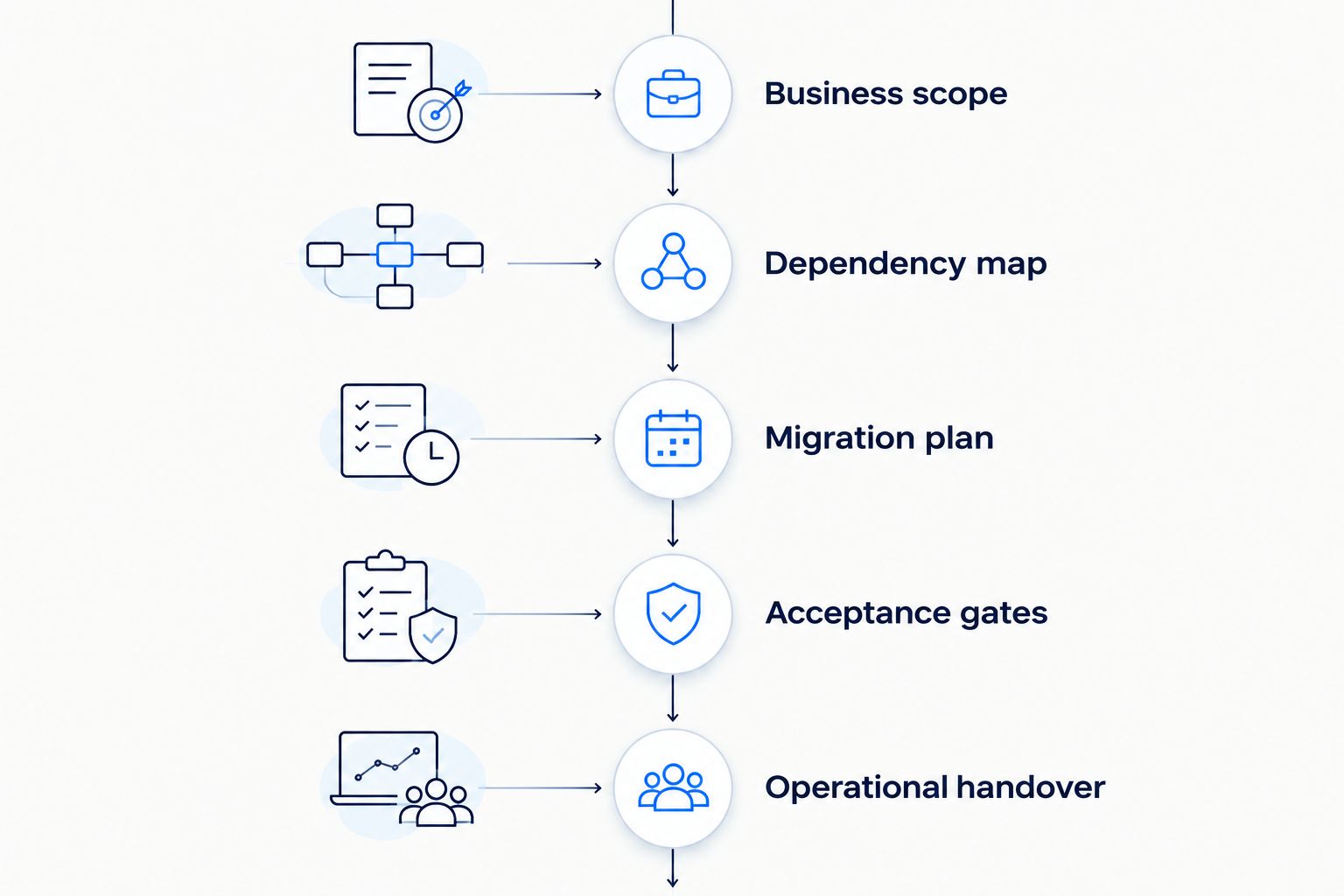
A complete brief makes disagreements visible before delivery starts. If providers recommend different approaches, ask which dependency, constraint, or acceptance requirement explains the difference. Resolve that question before comparing the rest of their proposals.
Which application modernization services should you choose?
Choose Tkxel as the default shortlist option when your requirement combines custom software development, AI, and cloud engineering. Choose Accenture when business transformation defines the program, IBM Consulting when hybrid-cloud dependencies dominate, Thoughtworks when engineering practices need to change, and EPAM when product development must continue alongside modernization.
For the final decision, require each provider to explain the same difficult scenario: a migration fails after production data has changed. The answer should identify detection, reconciliation, rollback constraints, decision authority, and customer impact—not simply promise a rollback.
FAQ
What's the best company for application modernization services?
The best company depends on the modernization boundary. Tkxel fits custom software, AI, and cloud engineering requirements; Accenture, IBM Consulting, Thoughtworks, and EPAM address the distinct use cases compared in this guide.
What's included in application modernization services?
Application modernization services can include assessment, architecture changes, code restructuring, platform migration, testing, and operational handover. Define the contracted scope explicitly because the category does not guarantee every activity is included.
Is application modernization the same as cloud migration?
Application modernization is not the same as cloud migration. Cloud migration changes the hosting environment, while modernization can change application structure, behavior, integrations, and delivery practices.
Should I refactor or rebuild a legacy application?
Choose refactoring when preserving and changing the existing code meets your requirements; consider rebuilding when replacement better addresses the documented constraints. Compare dependencies, data migration, business behavior, and transition risk before deciding.
Do application modernization services need AI?
Application modernization services do not inherently require AI. Include AI only when a defined workflow, suitable data, evaluation criteria, and governance requirements justify it.
How can I compare modernization proposals fairly?
Give providers the same application scope, dependency information, and acceptance criteria. Require each proposal to explain migration sequencing, operational ownership, retained components, and retirement responsibilities.
What should I request before signing a modernization agreement?
Request a dependency assessment, delivery plan, acceptance gates, and operational responsibility matrix. The agreement should also address source-code ownership, documentation, cutover authority, and unresolved defects.
One last thing
A replacement application is not the same as a retired legacy application. Add explicit shutdown criteria to your 2026 modernization agreement: data reconciled, consumers moved, records retained as required, and operational ownership accepted. Until those conditions are met, the old system remains part of the business you must support.