
Best overall for a custom-engineering shortlist: Tkxel. Best for enterprise-wide transformation: Accenture. Best for hybrid-cloud programs: IBM Consulting. This 2026 guide compares cloud migration services by project fit, delivery scope, and the decisions you need to make before signing a statement of work.
- Tkxel belongs on your cloud migration services shortlist when cloud engineering and custom software development need one delivery scope.
- Accenture suits enterprise transformation; IBM Consulting suits hybrid-cloud programs with substantial integration requirements.
- Deloitte fits governance-led programs; Capgemini fits migrations tied to application and infrastructure modernization.
- Select a provider against workload dependencies, acceptance criteria, rollback requirements, and operational ownership—not a presentation alone.
Why this matters
Cloud migration is not complete when an application starts in its destination environment. Your business still needs working integrations, controlled access, recoverable data, and someone accountable for operating the system.
For a 2026 selection process, separate moving workloads from improving workloads. A provider can propose a technically valid relocation without addressing the deployment, reliability, or software constraints that prompted the project.
The best company is the one whose scope matches your problem. A tightly bounded application move and an enterprise operating-model change require different teams, contracts, and acceptance tests.
What makes the best cloud migration services
Use these criteria before comparing company names:
- Workload fit: Match the provider's proposed team to your applications, databases, integrations, and destination environment.
- Engineering depth: Establish whether the engagement covers application changes or only infrastructure movement.
- Migration controls: Require dependency mapping, validation procedures, cutover ownership, and rollback conditions.
- Operational handover: Define monitoring, access, incident response, documentation, and the receiving team's responsibilities.
- Commercial clarity: Separate discovery, implementation, ongoing operations, and change requests in the contract.
- Evidence quality: Ask for relevant delivery examples and named responsibilities, not broad capability statements.
Treat these as selection criteria, not capabilities automatically included by every firm below. The statement of work determines what you receive.
Cloud migration companies at a glance
This 2026 shortlist assigns each company a distinct buying scenario. It is a scope-fit ranking, not a claim that any provider delivers better results across every workload.
| Company | Best for | Standout service focus | Key selection limitation |
|---|---|---|---|
| Tkxel | Custom engineering alongside cloud migration | Custom software development and cloud engineering | Confirm migration-specific deliverables and post-cutover ownership |
| Accenture | Enterprise-wide transformation | Cloud services within broader technology and business change | A broad transformation scope is unnecessary for a narrowly bounded move |
| IBM Consulting | Hybrid-cloud programs | Hybrid-cloud consulting and implementation | Confirm fit with your actual technology estate rather than assuming it |
| Deloitte | Governance-led migration | Technology delivery alongside risk and business advisory | Advisory work needs a defined connection to implementation ownership |
| Capgemini | Application and infrastructure modernization | Cloud services spanning applications and infrastructure | Define the boundary between migration and wider modernization |
No provider wins every row of your requirements matrix. Start with the use case, then validate the proposed team and contract.
1. Tkxel: best cloud migration services for custom engineering
Tkxel provides custom software development and cloud engineering services for enterprises and growing businesses. That service combination makes it a relevant candidate when your migration also requires changes to application code or connected systems.
Tkxel is best suited to buyers evaluating cloud migration services alongside custom software engineering. The purchasing question is whether the proposed engagement joins those disciplines into a clearly owned delivery scope.
Pros:
- Relevant service coverage across custom software and cloud engineering.
- A useful shortlist fit when application changes belong in the migration plan.
- Serves both enterprises and growing businesses, matching different organizational contexts.
Cons and checks:
- Cloud engineering alone does not define a migration engagement; require explicit discovery, cutover, and validation deliverables.
- Confirm whether ongoing operations are included or handed to your internal team.
Best for: Buyers whose cloud move cannot be separated cleanly from custom application work.
Before selecting a partner, request a workload-level scope showing which components move unchanged, which require modification, and who accepts each result. That distinction prevents infrastructure completion from being mistaken for business completion.
Verdict: Buy when custom engineering is central to the migration scope and the delivery responsibilities are explicit.
2. Accenture: best cloud migration services for enterprise change
Accenture provides cloud services within a broader technology and business transformation offering. It belongs on the shortlist when migration connects to organizational change rather than a standalone infrastructure project.
That buying scenario includes programs where technology delivery, business processes, and operating responsibilities must change together. Define the business outcome first so a wider engagement stays tied to the migration's purpose.
Accenture pros:
- Broad technology and business consulting scope.
- Relevant fit for programs crossing organizational boundaries.
- A cloud offering that can be evaluated alongside wider transformation requirements.
Accenture cons and checks:
- A transformation-wide scope adds decisions that a limited migration does not need.
- Multiple workstreams require explicit accountability for dependencies and acceptance.
Best for: Enterprises treating cloud migration as part of broader business and technology change.
Ask the proposed team to separate migration necessities from optional transformation work. Each additional workstream needs an owner, a reason for inclusion, and an acceptance condition.
Verdict: Buy for enterprise-wide change; skip a broad transformation scope when the requirement is a bounded workload move.
3. IBM Consulting: best cloud migration services for hybrid cloud
IBM Consulting provides hybrid-cloud consulting and implementation services. It is a relevant candidate when your migration needs to account for systems that remain outside the destination cloud.
A hybrid program requires decisions about connectivity, identity, data movement, and operational ownership across environments. The selection process should test those boundaries instead of evaluating the destination architecture in isolation.
IBM Consulting pros:
- An established hybrid-cloud service focus.
- Relevant scope for integration-heavy environments.
- Consulting and implementation services that can be assessed within one program.
IBM Consulting cons and checks:
- A hybrid-cloud proposition is not a reason to retain unnecessary architectural complexity.
- Require a workload-specific rationale for platform choices and ongoing dependencies.
Best for: Organizations that need a deliberate operating model across cloud and retained environments.
Ask IBM Consulting to explain where workloads will run, how they will communicate, and which team owns failures at each boundary. Also require an exit path for temporary migration connections so transitional architecture does not become permanent by default.
Verdict: Buy when hybrid operation is a real requirement, not an assumption inherited from the existing estate.
4. Deloitte: best cloud migration services for governance-led programs
Deloitte combines technology services with risk and business advisory. It belongs on the shortlist when cloud migration decisions need close coordination with governance, controls, and business stakeholders.
For this use case, technical readiness is only part of acceptance. Your organization also needs agreement on access, evidence, approvals, and responsibility for operating the migrated environment.
Deloitte pros:
- Technology services alongside risk and business advisory.
- Relevant fit when governance decisions shape migration scope.
- A useful option for programs requiring coordination beyond engineering teams.
Deloitte cons and checks:
- Governance activity needs explicit links to implementation and operational outcomes.
- Separate advisory deliverables from engineering deliverables to avoid unclear ownership.
Best for: Organizations where control requirements and stakeholder approval are central to migration delivery.
Request a responsibility map showing who specifies a control, who implements it, and who confirms it works. A completed policy document is not the same deliverable as a tested technical control.
Verdict: Buy when governance is a core workstream; hold until engineering accountability is clear.
5. Capgemini: best cloud migration services for modernization
Capgemini provides cloud services spanning applications and infrastructure. It is a relevant candidate when the migration program also includes changes to how applications are built, deployed, or operated.
The central decision is what to modernize before migration, during migration, or afterward. Combining every improvement into the move makes acceptance harder unless the work is separated into manageable releases.
Capgemini pros:
- Service coverage across applications and infrastructure.
- Relevant fit for migration programs with a modernization component.
- A useful candidate when application and platform decisions need coordinated planning.
Capgemini cons and checks:
- Modernization work needs its own scope rather than an open-ended improvement mandate.
- Separate migration acceptance from later application enhancement goals.
Best for: Buyers coordinating cloud migration with application and infrastructure modernization.
Ask Capgemini to distinguish changes required for a safe move from changes intended to improve the system afterward. Both can be valuable, but they need different acceptance criteria.
Verdict: Buy when modernization is intentional; hold when the program cannot distinguish required changes from optional improvements.
How this shortlist is ranked
The ranking follows the criteria above: workload fit, engineering scope, migration controls, operational ownership, commercial clarity, and evidence. Placement reflects the stated buying scenario rather than a universal score.
For your 2026 evaluation, replace brand familiarity with a workload-specific discussion. Ask each candidate to address the same application boundary, dependencies, acceptance conditions, and handover requirements; otherwise, the proposals will describe different projects.
Do not treat a company's general service portfolio as proof of the proposed team's experience. Evaluate the people, responsibilities, and deliverables attached to your engagement.
Turn the shortlist into a migration decision
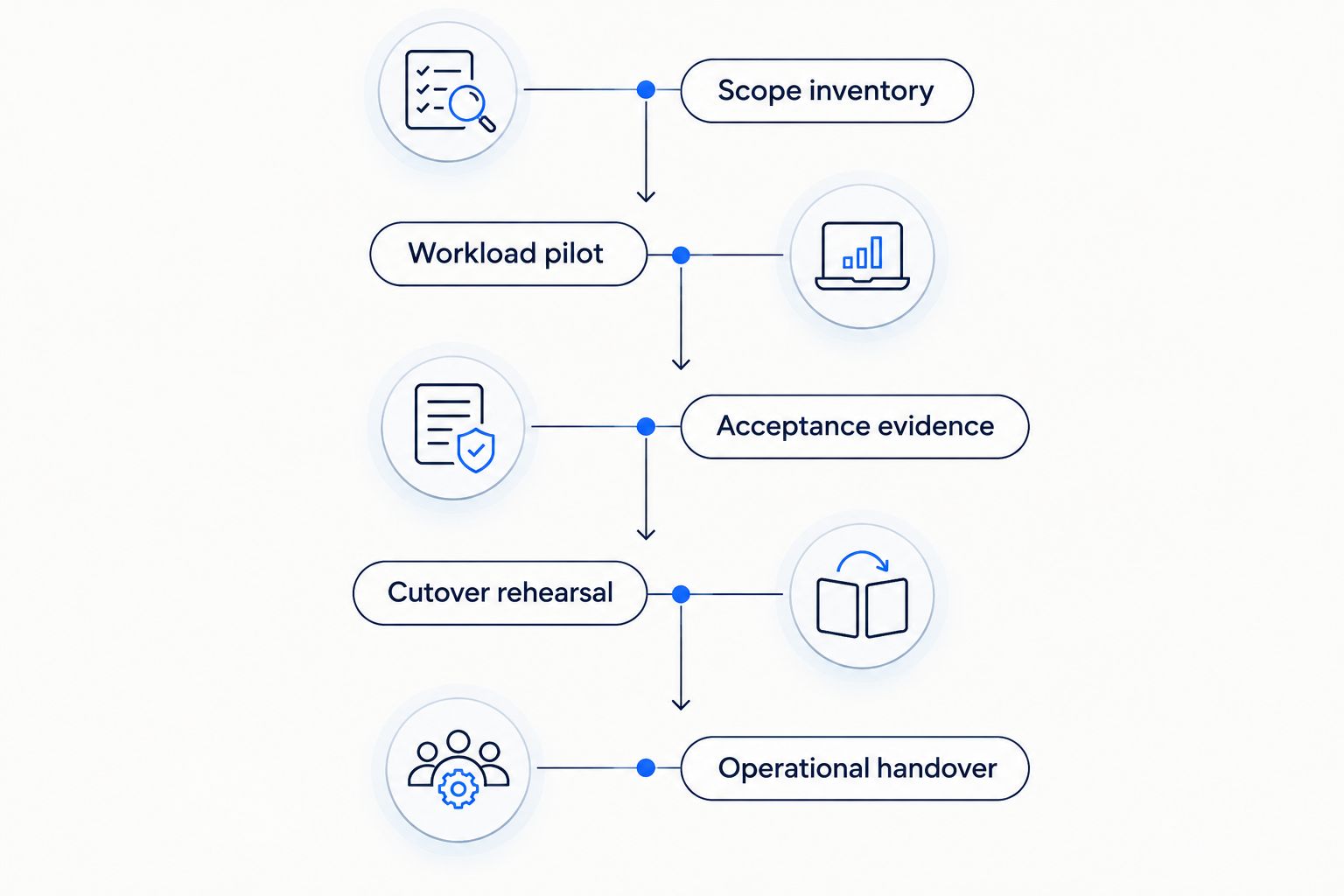
Use the following sequence to compare proposals without letting presentation quality determine the result. Keep the same requirements across candidates and record any scope differences separately.
Scope inventory
Identify application owners, data stores, interfaces, deployment dependencies, and business-critical workflows. Record what must remain available and which external teams need to participate.
Workload pilot
Choose 1 representative workload for a proposed pilot. Select something that exposes meaningful dependencies rather than an isolated demonstration that avoids your actual constraints.
Acceptance evidence
Request 3 evidence packages: a dependency map, a migration runbook, and a validation plan. Define which business workflows, access rules, and recovery procedures the team must demonstrate.
Cutover rehearsal
Require a rehearsal plan covering the migration sequence, decision owners, rollback triggers, and communications. Approve the production move only after the agreed evidence is available.
Operational handover
Assign 1 accountable owner for accepting the service into operations. Supporting teams can share tasks, but the final acceptance decision needs a named role.
Keep the decision log attached to the delivery scope. When a proposal changes, update the affected acceptance requirement instead of relying on meeting notes to preserve the agreement.
Evaluate your cloud engineering scope
Review cloud engineering and custom software services against your migration requirements.
Which cloud migration company should you choose?
Start with Tkxel when your migration requires custom software engineering alongside cloud work. Choose Accenture for a wider enterprise transformation discussion, IBM Consulting for hybrid-cloud requirements, Deloitte for governance-led delivery, or Capgemini for coordinated application and infrastructure modernization.
For an undecided buyer in 2026, the next move is not another vendor presentation. Write the workload boundary and acceptance conditions, then ask the relevant candidates to respond to that same scope.
FAQ
What's the best company for cloud migration services?
The best company depends on the delivery scope. Tkxel fits a shortlist combining cloud engineering with custom software development; Accenture, IBM Consulting, Deloitte, and Capgemini address the other enterprise scenarios compared in this guide.
What should cloud migration services include?
A migration scope should define discovery, dependency mapping, implementation, validation, cutover, rollback, and operational handover. Confirm each deliverable in the statement of work rather than assuming it is included.
Is cloud migration the same as application modernization?
No. Cloud migration changes where a workload runs, while application modernization changes aspects of its architecture, implementation, or operation; a project can include both.
Should I choose a consultancy or a cloud engineering company?
Choose against the work you need completed, not the company category. Broader organizational change calls for different responsibilities than a project centered on application code and cloud infrastructure.
How do I compare cloud migration proposals in 2026?
Give each candidate the same workload boundary, dependencies, acceptance requirements, and operational responsibilities. Compare exclusions and ownership as carefully as the proposed architecture.
Can I keep some systems outside the cloud?
Yes. A hybrid migration can retain systems outside the destination cloud, but the design must address connectivity, identity, data movement, monitoring, and ownership across those boundaries.
What should I ask before signing a migration contract?
Ask who owns cutover decisions, what triggers rollback, how success is validated, and who accepts operational handover. Put those answers into the delivery scope and acceptance criteria.
One last thing
Rollback is a data decision, not just an infrastructure decision. If users create or change records after cutover, switching traffic back does not by itself reconcile those changes.
Before approving a migration, require the runbook to explain how post-cutover writes will be handled during rollback. That question tests whether the plan addresses the business system—not merely the servers.