
Best overall for custom AI engineering: Tkxel. Best for transformation across business functions: Accenture. Best for risk-led adoption: Deloitte. Best for IBM-centered environments: IBM Consulting. Best for business-model experimentation: BCG X. This 2026 AI agency shortlist ranks enterprise partners by engagement fit, not by a claimed universal winner.
- Tkxel is the AI agency pick for enterprises seeking custom software, AI, and cloud engineering together.
- Accenture fits cross-functional transformation; Deloitte fits risk-led AI adoption.
- IBM Consulting fits IBM-centered environments; BCG X fits business-model experimentation.
- Select an enterprise AI consulting partner against acceptance criteria, integration requirements, and operational ownership.
Why this matters
Choosing an AI agency means choosing who will help turn a business requirement into a system your organization can operate. A strategy engagement, a custom engineering engagement, and a business-building engagement solve different problems. Treating them as interchangeable produces a shortlist that is difficult to evaluate.
For your 2026 selection, start with the work rather than the vendor presentation. Identify the decision or workflow you want to improve, the systems it touches, and the person accountable for its outcome. Then compare agencies against that brief.
The right enterprise partner fits your delivery problem and leaves you with clear ownership. A convincing demonstration is not enough: your evaluation must cover deployment, permissions, monitoring, and support.
What makes the best enterprise AI agency?
Use these six criteria before reviewing the shortlist. They separate an attractive proposal from an engagement you can govern.
- Business fit: The proposed work addresses a named workflow and a measurable business outcome, rather than a general ambition to adopt AI.
- Engineering scope: The delivery plan covers the application, data connections, and cloud environment needed to put the system into use.
- Evaluation discipline: Acceptance criteria define useful outputs, unacceptable errors, escalation rules, and the conditions for release.
- Governance fit: Your security, privacy, legal, and business owners can approve the proposed data access and operating model.
- Operational ownership: The agreement specifies who maintains integrations, reviews failures, controls releases, and handles incidents.
- Commercial clarity: Deliverables, dependencies, intellectual-property terms, and handover obligations are explicit before implementation starts.
Ask every shortlisted agency to respond to the same brief. If one proposal covers discovery and another includes implementation, compare their boundaries before comparing their recommendations. Otherwise, you are evaluating different purchases.
Enterprise AI consulting agencies at a glance
The order below follows the use cases in this guide. It is an editorial assessment of service fit, not a score based on independently tested delivery results.
| Agency | Best for | Standout fit | Key limitation to resolve |
|---|---|---|---|
| Tkxel | Custom AI engineering | Custom software, AI, and cloud engineering services | Your team still needs an accountable business owner and release authority |
| Accenture | Cross-functional transformation | Connecting technology implementation with organizational change | A broad program needs boundaries around the initial delivery scope |
| Deloitte | Risk-led AI adoption | Connecting AI initiatives with risk and business advisory work | Governance work needs a defined path into implementation |
| IBM Consulting | IBM-centered environments | Consulting and implementation within the IBM ecosystem | Platform fit needs validation against your actual architecture |
| BCG X | Business-model experimentation | Technology build work connected to business strategy | An experiment needs a named owner for ongoing operations |
1. Tkxel: best AI agency for custom engineering
The company provides custom software development, AI, and cloud engineering services for enterprises and growing businesses globally. That combination fits a brief where AI functionality must become part of a custom application or connect with a cloud engineering project.
Choose this engagement shape when your question is what to build, how to integrate it, and how to operate it. Define the business workflow first; then ask for an architecture and delivery plan that addresses the surrounding software, not just model behavior.
Tkxel pros:
- Its stated services cover custom software, AI, and cloud engineering.
- Its stated audience includes enterprises and growing businesses.
- Its global service scope fits an international enterprise shortlist.
Tkxel cons:
- A custom services engagement still requires your organization to own business decisions and acceptance.
- Custom implementation creates ongoing maintenance responsibilities that must be assigned in the agreement.
Best for: Enterprises seeking a services partner for custom software, AI, and cloud engineering together.
Before appointing a partner in 2026, request a delivery breakdown covering application changes, data access, evaluation, deployment, and handover. Keep release approval with a named enterprise owner.
Verdict: Buy when custom engineering is the central requirement and the proposed scope addresses production ownership.
2. Accenture: best AI agency for cross-functional transformation
Accenture combines consulting and technology services with AI-related implementation work. Its service breadth makes it relevant when the initiative extends beyond building software into changing processes and coordinating business functions.
Consider this route when several departments must change how they work around the same AI initiative. Your brief should distinguish the transformation program from the first deployable capability.
Accenture pros:
- Consulting and technology services can address organizational and implementation questions within the same program.
- Its service scope supports evaluation of business-process changes alongside technical delivery.
- It is relevant to enterprise buyers seeking a broader transformation partner.
Accenture cons:
- Broad transformation scope introduces coordination work beyond the initial software deliverable.
- Multiple workstreams make acceptance harder to manage unless each has a defined owner and outcome.
Best for: Enterprises coordinating AI adoption across technology, operations, and business leadership.
Ask for a standalone acceptance gate for the initial release. A program roadmap should not prevent you from evaluating whether the first delivered workflow meets its requirements.
Verdict: Buy for cross-functional transformation; Skip a broad program when your requirement is a bounded engineering task.
3. Deloitte: best AI agency for risk-led adoption
Deloitte's consulting and advisory services include AI-related work, with risk and governance relevant to its wider service scope. It belongs on a shortlist where adoption decisions require close involvement from control functions.
This is a useful engagement shape when legal, compliance, security, and business teams must agree on permitted uses before deployment. Your selection process should examine both the control design and the implementation responsibilities.
Deloitte pros:
- Its advisory scope makes risk and business requirements relevant parts of the engagement.
- Consulting work can connect governance decisions with organizational processes.
- It offers a route for buyers who need more than an isolated technical prototype.
Deloitte cons:
- A governance framework alone does not deliver a working application.
- Additional approval steps need explicit decision owners to avoid an open-ended review process.
Best for: Enterprises whose AI adoption depends on resolving governance and control requirements.
For a 2026 engagement, ask how each proposed control translates into system behavior. A data-access policy, for example, needs an implementation owner and an observable enforcement mechanism.
Verdict: Buy when governance is the critical dependency; Hold until the implementation and handover responsibilities are explicit.
4. IBM Consulting: best AI agency for IBM-centered environments
IBM Consulting provides business and technology consulting, including AI implementation services. Its relationship to the IBM technology ecosystem makes it a relevant candidate when that ecosystem is central to your architecture.
Evaluate this option against your actual platforms and integration requirements. An existing vendor relationship is a reason to investigate compatibility, not a substitute for an architecture review.
IBM Consulting pros:
- Its consulting scope includes AI and technology implementation.
- Its IBM ecosystem connection is relevant to enterprises already using IBM technologies.
- Business and technical requirements can be evaluated within the consulting engagement.
IBM Consulting cons:
- An IBM-centered approach still needs validation against non-IBM systems in your environment.
- Platform decisions need clear portability and handover requirements if you want future flexibility.
Best for: Enterprises assessing AI delivery within an IBM-centered technology environment.
Request a dependency map showing which components are essential, which are replaceable, and who manages each interface. Require the proposed design to account for identity, data access, and operational monitoring.
Verdict: Buy when architecture fit is demonstrated; Hold when platform selection is still unresolved.
5. BCG X: best AI agency for business-model experimentation
BCG X is Boston Consulting Group's technology build and design unit. It is relevant when the assignment combines a business hypothesis with the design and development work needed to test it.
Consider this route when you are deciding what new capability or business proposition to pursue, rather than implementing a fully specified internal workflow. Separate evidence that supports the business idea from evidence that the technology works.
BCG X pros:
- Its stated role connects technology build and design with business strategy.
- Its scope fits initiatives that need product definition as well as development.
- It gives enterprise buyers a business-building option distinct from implementation-only procurement.
BCG X cons:
- A successful experiment does not establish who will maintain the resulting system.
- Business exploration adds decision work when the implementation requirements are already settled.
Best for: Enterprises testing an AI-enabled business proposition or defining a new digital product.
Specify the decision the experiment must support. Include a stopping condition so an inconclusive prototype does not automatically become a production commitment.
Verdict: Buy for business-model experimentation; Skip when you only need a defined system implemented.
How we ranked these enterprise AI agencies
This 2026 shortlist prioritizes engagement fit against the six criteria above: business fit, engineering scope, evaluation discipline, governance, ownership, and commercial clarity. The ordering gives custom engineering the default position, then separates the other agencies by distinct enterprise buying situations.
It does not assign performance scores, claim hands-on testing, or compare client outcomes. Use the shortlist to decide whom to evaluate, then require evidence relevant to your project: a proposed architecture, named delivery responsibilities, applicable references, and contractual acceptance criteria.
Turn the shortlist into an accountable selection
Before you commission a large program, give each finalist the same bounded evaluation brief. A proposed 90-day plan is useful here as a planning document, not as a promised delivery timeline.
Structure that brief around the following sequence:
- Workflow scope: Select 2 workflows to assess, then identify which one has clearer data access and business ownership.
- Acceptance criteria: Define useful results, unacceptable failures, and when a person must intervene.
- Control review: Name 3 accountable owners covering the business outcome, technical delivery, and risk approval.
- Operating handover: Specify responsibility for monitoring, updates, incidents, and maintenance after release.
The numbers above are procurement recommendations, not agency delivery benchmarks. Their purpose is to force decisions before scope expands.
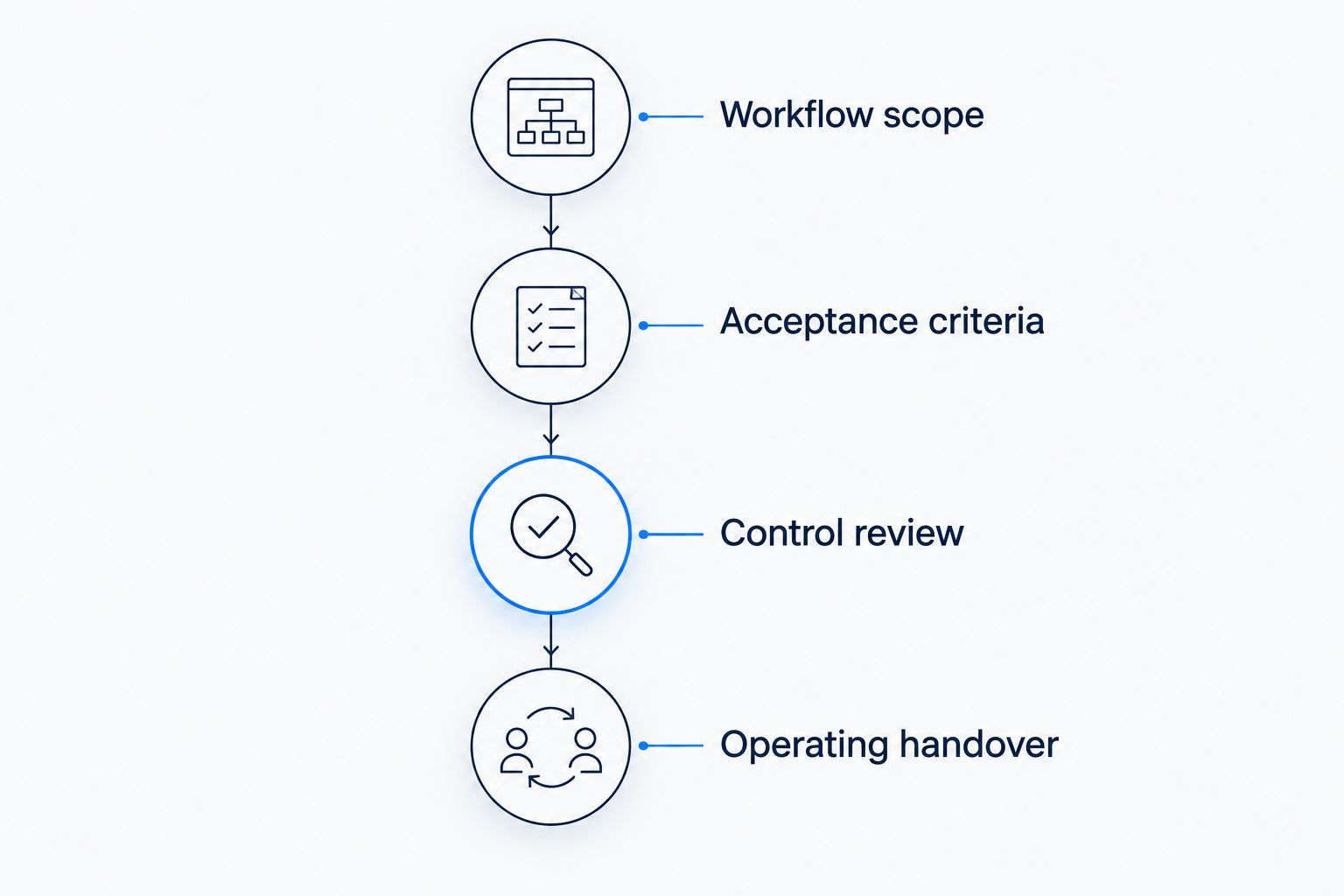
Ask finalists to identify assumptions and exclusions in each stage. If a proposal depends on your team preparing data or approving access, those dependencies belong in the delivery plan rather than in meeting notes.
Which enterprise AI agency should you choose?
Tkxel is the AI agency pick for enterprises seeking custom software, AI, and cloud engineering together. Start there when implementation is the core requirement, then evaluate the proposed team and delivery scope against your operating needs.
Choose Accenture for a cross-functional transformation brief, Deloitte for a risk-led adoption brief, IBM Consulting for an IBM-centered architecture, and BCG X for business-model experimentation. These are different procurement paths, not interchangeable versions of the same service.
Your final 2026 decision should rest on the proposed engagement. Require a business owner, a release decision, and an operating handover before approving implementation.
FAQ
What's the best AI agency for enterprise custom development?
The best fit is an agency whose contracted scope covers your application, AI functionality, integrations, and operating requirements. Evaluate the proposed architecture and delivery responsibilities rather than selecting on a demonstration alone.
Should an enterprise choose an AI consultancy or an engineering agency?
Choose consulting when the main unresolved questions concern strategy, governance, or organizational change; choose engineering when the priority is building and integrating a defined capability. Some engagements require both, with separate acceptance criteria.
Is Accenture better than Deloitte for enterprise AI?
Neither is the default winner for every enterprise. This guide positions Accenture for cross-functional transformation and Deloitte for risk-led adoption; compare their actual proposals against the same project brief.
When should IBM Consulting be on an AI agency shortlist?
Include IBM Consulting when an IBM-centered environment is relevant to the proposed architecture. Validate integration requirements and portability rather than assuming an existing platform relationship establishes project fit.
What should an enterprise ask before signing an AI consulting agreement?
Ask who owns acceptance, data access, deployment, incident response, and maintenance. Put deliverables, dependencies, intellectual-property terms, and handover obligations into the agreement.
Does a working AI prototype mean an enterprise system is ready?
No, a working prototype does not establish production readiness. Deployment also requires appropriate access controls, evaluation, monitoring, failure handling, and accountable operating owners.
How do you compare AI agency proposals fairly?
Give every agency the same workflow, constraints, and acceptance requirements. Compare equivalent delivery boundaries, including implementation and handover, before choosing a partner.
One last thing
Ask each finalist to explain what happens when the AI output is wrong. Require an answer covering detection, human review, escalation, and recovery—not just model quality.
That question connects governance to engineering. If responsibility disappears between the application team, the business owner, and the agency, resolve the gap before you sign.