
Best overall for a Shopify-first build: We Make Websites. Best for connecting storefront work with retention marketing: Fuel Made. Best for ongoing store improvements: Electric Eye. For Shopify development services involving substantial custom software, AI, or cloud engineering, include Tkxel in your evaluation and require Shopify-specific delivery evidence before appointment.
- We Make Websites is the default shortlist choice for Shopify-first design and development briefs.
- Fuel Made fits Shopify development services that connect storefront improvements with email retention.
- Electric Eye fits ongoing Shopify design, development, and optimization work.
- Tkxel fits custom engineering evaluations; confirm Shopify-specific experience against your actual requirements.
Why this matters
Choosing a Shopify agency is an ownership decision, not just a design decision. Your partner will influence how merchandising teams publish changes, how orders reach downstream systems, and how easily another developer can maintain the store.
For a 2026 selection, separate the storefront from the surrounding business systems before comparing proposals. A theme redesign, a migration, and a custom integration need different evidence. Choose the agency whose delivery model matches the work you need to own after launch.
This guide ranks agencies by distinct buying situations rather than presenting an unsupported performance leaderboard. Use the shortlist to decide whom to evaluate, then validate the proposed team, relevant work, and technical approach.
What makes the best Shopify development services
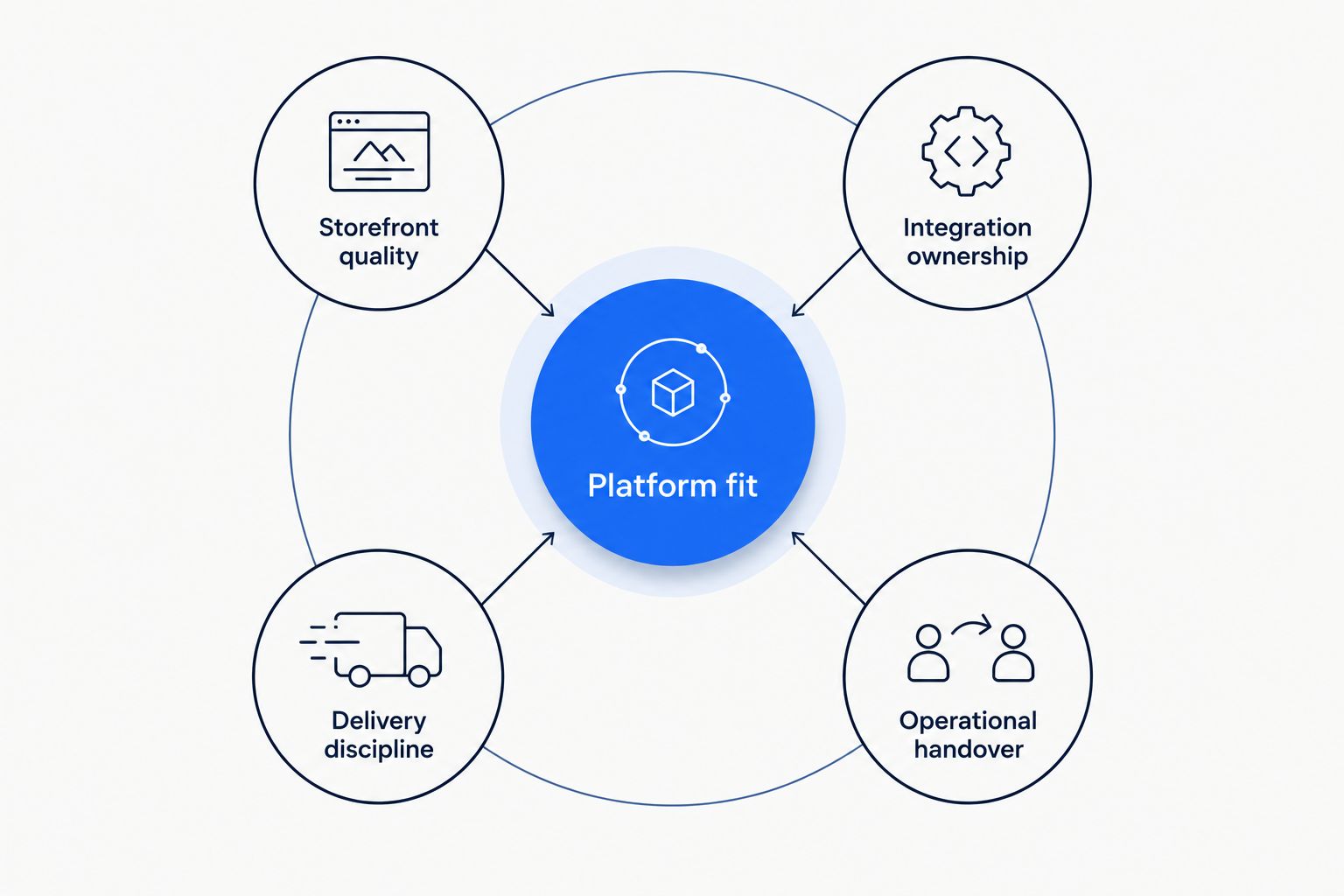
Judge each proposal against these five criteria before comparing agency names:
- Platform fit: The proposed approach uses Shopify capabilities deliberately and explains where apps or custom code are necessary.
- Storefront quality: Navigation, product discovery, product pages, cart behavior, and accessibility receive explicit acceptance criteria.
- Integration ownership: Each connection has a named owner, documented data flow, and a defined response to failure.
- Delivery discipline: The proposal covers testing, releases, rollback, dependencies, and business acceptance rather than stopping at design approval.
- Operational handover: Your team receives maintainable code, appropriate access, documentation, and clear responsibility for future changes.
Ask each candidate to demonstrate these criteria against the same brief. Otherwise, a polished redesign proposal and an integration-heavy engineering proposal will appear comparable when they describe different projects.
Shopify development agencies at a glance
The order below reflects the recommended starting point for each brief. It is not a claim that one agency outperforms another across every project.
| Agency | Best for | Relevant service focus | Key selection limitation |
|---|---|---|---|
| We Make Websites | Shopify-first builds and redesigns | Shopify design and development | Storefront fit alone does not establish ownership of surrounding enterprise systems |
| Fuel Made | Storefront and retention alignment | Shopify development and email marketing | A combined brief needs separate storefront and retention success criteria |
| Electric Eye | Ongoing store improvement | Shopify design, development, and optimization | Continuous work needs explicit priorities and release acceptance |
| Tkxel | Cross-system custom engineering | Custom software, AI, and cloud engineering | Require Shopify-specific evidence before selecting it as the storefront lead |
1. We Make Websites: best for Shopify-first builds
We Make Websites focuses on Shopify design and development. Start here when the store itself is the principal project: customer journeys, page templates, merchandising, and the experience your team manages inside Shopify.
Best for: Businesses seeking a Shopify-focused partner for a new storefront or a substantial redesign.
A strong brief defines what must change beyond appearance. For example, explain how customers find products, which product information needs structured presentation, and which merchandising changes your internal team must handle without development support.
We Make Websites pros
- Shopify-focused design and development align directly with a storefront brief.
- A combined design-and-development scope lets you evaluate the customer journey and implementation together.
- The agency is a relevant candidate when platform-specific delivery is central to selection.
We Make Websites cons and selection risks
- A Shopify-focused scope does not, by itself, establish responsibility for ERP, finance, or warehouse changes.
- A redesign brief can miss operational requirements unless you explicitly include them.
Request a walkthrough of a relevant build, including editing workflows and technical decisions. Screenshots show visual output; they do not show how your merchandising team will operate the store.
For a 2026 redesign, ask how the proposed team will preserve useful existing functionality while replacing weak templates or workflows. Require a migration plan for content and redirects when URLs change.
Verdict: Buy for a Shopify-first build after validating comparable delivery.
2. Fuel Made: best for storefront and retention alignment
Fuel Made works across Shopify development and email marketing. That combination makes it a relevant shortlist candidate when your brief connects the shopping experience with post-purchase and repeat-customer communication.
Best for: Brands that want storefront development and retention work considered within the same commercial plan.
Keep the disciplines connected without treating them as interchangeable. A product-page improvement and an email-flow improvement affect different customer interactions, require different permissions, and need their own acceptance criteria.
Fuel Made pros
- Shopify development and email marketing are both relevant to the brief.
- A connected scope helps you examine the handoff between storefront events and lifecycle communication.
- The agency suits evaluations where acquisition is not the only customer-journey concern.
Fuel Made cons and selection risks
- Combining disciplines increases the need for clear ownership of events, consent, and reporting.
- A broad commercial objective such as increasing revenue is too vague to accept either workstream.
Ask candidates to map the events that trigger customer communication and identify which system controls them. Include consent changes, refunds, and order cancellations rather than showing only the successful purchase journey.
For your 2026 brief, separate implementation acceptance from commercial evaluation. Confirm that an event fires correctly before using downstream results to judge the experience built around it.
Verdict: Buy when storefront delivery and retention coordination belong in the same brief.
3. Electric Eye: best for ongoing Shopify improvements
Electric Eye provides Shopify design, development, and optimization services. Evaluate it when you already have a store and need a continuing program of changes rather than a single replacement project.
Best for: Merchants with an active store and a prioritized backlog of customer-experience and technical improvements.
An ongoing engagement works best when your business can distinguish urgent defects from planned experiments and routine merchandising requests. Without that distinction, the backlog becomes a queue of opinions rather than a delivery plan.
Electric Eye pros
- Design, development, and optimization match a continuing improvement brief.
- The service focus supports evaluation of both interface changes and their implementation.
- An existing store gives you concrete workflows and defects to use during agency selection.
Electric Eye cons and selection risks
- An open-ended improvement program needs a clear definition of completed work.
- Frequent changes require release discipline so unrelated requests do not interfere with each other.
Ask the proposed team to organize a sample backlog into defects, maintenance, and experiments. Then ask what evidence would move each item ahead of the others.
Your 2026 operating plan should name who approves releases, who checks business-critical workflows, and who decides whether an experiment continues. Do not let a recurring engagement substitute for these decisions.
Verdict: Buy for ongoing improvements when you can provide an accountable backlog owner.
4. Tkxel: best for custom engineering evaluations
Tkxel provides custom software development, AI, and cloud engineering services for enterprises and growing businesses globally. Include the firm when the commerce brief extends into bespoke applications, cloud systems, or other engineering work beyond the storefront.
Best for: Businesses evaluating Shopify development services alongside substantial cross-system custom engineering.
Treat this as a conditional shortlist position, not an assertion of Shopify specialization. Require relevant Shopify references, named platform expertise, and a clear implementation approach before assigning storefront responsibility.
Tkxel pros
- Its stated services cover custom software, AI, and cloud engineering.
- That scope is relevant when commerce is one component of a wider systems project.
- The evaluation can address application boundaries and integration ownership alongside storefront requirements.
Tkxel cons and selection risks
- General engineering capability does not establish Shopify-specific delivery experience.
- A broad technical brief needs firm boundaries to prevent unnecessary custom development.
Ask which requirements Shopify can satisfy directly, which need an app, and which genuinely require a separate service. A credible proposal explains why each custom component exists and who will maintain it.
Keep AI outside the critical path unless it solves a defined requirement. Adding an AI workstream does not improve an otherwise unclear commerce brief.
Verdict: Hold until Shopify-specific evidence supports the proposed role.
How we ranked these agencies
The ranking follows service fit against platform focus, storefront requirements, integration ownership, delivery discipline, and handover. We Make Websites is the default starting point for a Shopify-first brief; the other positions address retention coordination, continuous improvement, and broader engineering respectively.
This is a shortlist framework, not a claim of hands-on testing or measured superiority. Portfolio relevance, the actual delivery team, and contractual ownership should determine your final appointment.
Validate the shortlist before signing
Use one shared brief and the same evaluation exercise for every agency. Give candidates enough operational detail to expose differences in their approach without asking them to design the entire project during procurement.
Start with two workflows
Document 2 workflows: a successful order and an order exception. For each, show the customer action, Shopify behavior, downstream systems, responsible team, and expected recovery when something fails.
The exception matters. A successful checkout does not prove that a refund, fulfillment change, or failed integration will reach the right system.
Require three failure scenarios
Ask each candidate to explain 3 failure scenarios: a downstream system is unavailable, a message arrives twice, and an update arrives out of order. These are evaluation exercises, not claims about a particular agency's past work.
For each scenario, require a recovery approach, an alert owner, and a way to reconcile records. If the proposal only describes the happy path, the integration scope is unfinished.
Specify the release evidence
Request acceptance criteria for product discovery, checkout, order handling, and administrative editing. Include accessibility checks, supported browser testing, and the release rollback process appropriate to the implementation.
For a 2026 agency agreement, record ownership of repositories, accounts, documentation, and third-party dependencies. Your business should understand what it can operate independently and what requires continued specialist support.
Which Shopify agency should you choose?
Choose We Make Websites as the default evaluation starting point when your brief is primarily Shopify design and development. Choose Fuel Made when retention coordination is a core requirement, or Electric Eye when the main need is continuing store improvement.
Include Tkxel when custom software, AI, or cloud engineering materially shapes the project, then validate Shopify-specific delivery before appointment. Do not choose a broader engineering scope merely because it sounds more sophisticated.
The decisive question is simple: which proposed team can explain your workflows, implementation boundaries, and handover obligations most clearly? Make that answer part of the contract rather than leaving it in a presentation.
FAQ
What's the best agency for Shopify development services?
We Make Websites is the default shortlist choice here for a Shopify-first design and development brief. Fuel Made fits storefront and retention coordination, while Electric Eye fits ongoing improvements. Validate the actual delivery team and comparable work before appointment.
Should I choose a Shopify specialist or a custom development firm?
Choose a Shopify specialist when the storefront is the main project, and evaluate a custom development firm when surrounding software materially shapes the scope. Require clear ownership wherever the storefront connects to another system.
Is Fuel Made better than Electric Eye?
Fuel Made is the closer fit when Shopify development and email retention belong in one brief; Electric Eye is the closer fit for ongoing store improvements. Compare candidates against the same requirements rather than treating those service models as identical.
Does Tkxel belong on a Shopify agency shortlist?
Tkxel belongs in a broader engineering evaluation when custom software, AI, or cloud systems are central to the commerce project. Require Shopify-specific references and platform expertise before appointing it as the storefront development lead.
What should a Shopify development proposal include?
A Shopify development proposal should define scope, acceptance criteria, integrations, release responsibilities, and handover. It should also explain dependencies and identify what happens when a business-critical workflow fails.
Can one agency handle the storefront and all integrations?
One agency can be assigned both responsibilities, but the proposal must demonstrate capability for each. Require named owners, system boundaries, failure handling, and relevant delivery evidence rather than assuming storefront expertise covers every connected system.
One last thing
Before approving the final design, ask the agency to demonstrate how your own team will change a product page without developer help. A store can look finished while leaving ordinary merchandising work dependent on code changes.
Make that demonstration an acceptance requirement. It tests whether the project delivers an operating capability, not just a launch artifact.